Speaker: Lora Sims
Data & Technology
Featured Resource
Technology is constantly changing and prosecution must change with it. From actual evidence to the data that determines crime trends, keeping up with the latest in tech can be overwhelming. Our resources dive into the expansive field with a focus on emerging technology as it relates to evidence and how data can shape the work of a prosecutor.
-

Responsible Use of Facial Recognition Technology
-

Investigative Uses of video doorbells: A Guide for Prosecutors
Author: PCE
A new form of evidence can now be found at millions of households across the country. The video doorbell, a device providing a live stream from the front door directly to a person’s phone, has already been used as evidence in countless cases. See how it can be used, the challenges of using a device, and more in our guide for prosecutors:
-
Technology and Prosecution – The Evolving Courtroom
Author: PCE
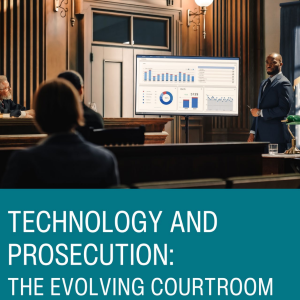
Advances in technology are quickly changing the longstanding practices of traditional courtrooms. With this evolution, prosecutors must weigh the opportunities these advancements create against the legal and ethical duties of criminal litigation, as well as the practical considerations about the quality and reliability of any emerging technology. From remote appearance technology to artificial intelligence to data analytics, we explore the role of technology in the modern courtroom in our recent publication:
PCE Videos
Additional PCE Resources
-
PCE NBP Committee Meeting: The Future of Prosecution Data
On April 4 -5 PCE’s National Best Practices Committee held an in-person meeting on “The Future of Prosecution Data”. The meeting was sponsored by the Karpel Foundation.

-
PCE Videos: The Prosecutors’ Crime Analyst: An Essential Employee (Parts 1 and 2)
On October 18, 2022, PCE hosted part one of a series on how crime analysts can improve prosecutions. On September 29, 2023, PCE hosted part two of the series.
Read More -
SAO Uses Statewide Sentence Data to Make Plea Offers More Equitable (2022)

Office of the Florida State Attorney, 8th Judicial District (Gainesville, FL)
The SAO8th has partnered with Technologies for Justice to harness sentencing data from the Florida Department of Corrections in order to provide prosecutors with information about average sentences imposed for similarly situated offenders.
Read More -
Automated Expungements (2022)
Santa Clara County District Attorney’s Office (San Jose, CA)
The Santa Clara District Attorney’s Office (SCDA) has developed a way to automate the expungement of criminal records by partnering with the Court and Public Defender.
Read More -
The Prosecutor’s Crime Analyst – An Essential Employee
Authors: PCE and Gaelin Bernstein
Read about the various essential tasks that a crime analyst can perform in a prosecutor office.
-
Public Police Conduct Disclosure Website (2022)
Arizona Prosecuting Attorney’s Advisory Council (Phoenix, AZ)
The APAAC has developed a public, internet accessible database that contains names of law enforcement officers for whom there are materials which must be provided in discovery in order to comply with Brady v. Maryland and its progeny.
Read More -
Yolo County District Attorney’s Office Commons Data Transparency Portal (2021)
Yolo County District Attorney’s Office (Woodland, CA)
Created with nonprofit Measures for Justice, the Commons Data Transparency Portal aims to be transparent about the work of the Yolo County District Attorney’s Office and to influence policy.
Read More -
Philadelphia District Attorney’s DATA Lab (2019)
Philadelphia District Attorney’s Office (Philadelphia, PA)
In November of 2019, the DATA (District Attorney’s Transparency Analytics) Lab was established in the Philadelphia District Attorney’s Office with the launch of a data dashboard.
Read More -
King County Prosecuting Attorney’s Office Data Dashboard (2020)
King County Prosecuting Attorney’s Office (King County, WA)
Utilizing the office’s Prosecutor by Karpel case management system to examine data, the King County Prosecuting Attorney’s Office published a public data dashboard using Microsoft Power BI.
Read More -
Florida State Attorney’s Office, Fourth Judicial Circuit, Data Dashboard (2020)
Office of the State Attorney of the Fourth Judicial Circuit (Jacksonville, FL)
Created with Florida International University and Loyola University of Chicago, the Office of the State Attorney of the Fourth Judicial Circuit‘s data dashboard focuses on prosecutorial performance indicators (PPIs).
Read More -
Prosecutor Data – Where is it Now and Where is it Going?
Author: PCE
This paper gives an overview of the current state of prosecution data, summarizes the data challenges faced by prosecutors, identifies new trends that are springing up in prosecutor offices, and poses questions for the future.
-
PCE Pop-Up: Data Dashboards
On February 3, 2022, the PCE Pop-Up focused on Data Dashboards.
Read More -
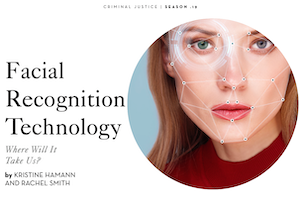
Facial Recognition Technology: Where Will It Take Us?
Author(s): Kristine Hamann and Rachel Smith
This paper addresses facial recognition technology used by law enforcement to enhance surveillance capabilities and the associated legal issues it raises.
-
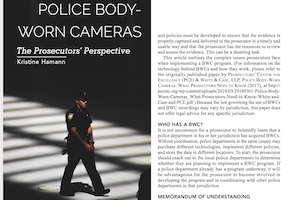
Police Body-Worn Cameras: The Prosecutors’ Perspective
Author(s): Kristine Hamann
As police departments across the United States embrace the use of police body-worn cameras, the cameras will inevitably capture a great deal of evidentiary material that will be useful in every type of criminal prosecution.
-
Police Body-Worn Cameras: What Prosecutors Need to Know
Author(s): Kristine Hamann, PCE
It is imperative that prosecutors be involved in the BWC uptake process as early as possible. The cameras will inevitably capture a great deal of evidentiary material that will be used in every type of criminal prosecution.
.
-
The Benefits of Electronic Discovery in King County
Author(s): Kristine Hamann, PCE
The development of an electronic discovery system will significantly benefit a prosecutor’s office by providing accurate records, a speedier process and appropriate accountability for all parties.