Author: PCE NBP
PCE Videos: How Prosecutors Help Fight Workplace Crimes and Injustice

On February 7, 2023 PCE hosted a Pop-Up on workplace crimes and injustice.
Read More
On February 7, 2023 PCE hosted a Pop-Up on workplace crimes and injustice.
Read More
On January 27th, 2023 PCE hosted a National Best Practices Committee meeting on the Office of the Future, which explored topics that the modern prosecutor should consider as they adapt to a changing landscape.
Read More
Your case rests on your evidence. In the last decade, the possibilities for that evidence have increased immensely. So how do you deal with it all? Our resources dive into new technologies, staffing needs, and more.
Author: PCE NBP
Speaker: John Wixted

On September 9, 2025 PCE hosted a Pop-Up on Science-Based Interviewing. It focused on prosecutor’s use of evidence backed techniques grounded in psychology and cognitive science to gather accurate and reliable information from witnesses, victims, and suspects. These methods prioritize rapport-building and open-ended questioning to reduce bias, enhance recall, and strengthen the quality of evidence. If you are interested in the meeting materials, please contact PCE.
Read More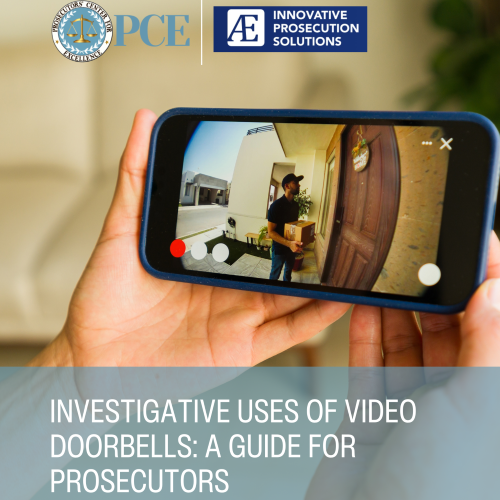
Author: PCE
A new form of evidence can now be found at millions of households across the country. The video doorbell, a device providing a live stream from the front door directly to a person’s phone, has already been used as evidence in countless cases. See how it can be used, the challenges of using a device, and more in our guide for prosecutors:
On September 9, 2024 PCE and AE hosted a webinar about digital evidence at trial, a sequel to our PCE Pop-Up The Good, the Bad and the Ugly of Digital Evidence.
Read MoreOn May 9, 2024 PCE hosted a webinar about how to effectively use digital evidence in a time of technological change. Speakers discuss legal considerations of AI, and more.
Read MoreOn October 18, 2022, PCE hosted part one of a series on how crime analysts can improve prosecutions. On September 29, 2023, PCE hosted part two of the series.
Read MoreAuthors: PCE, National Policing Institute
This article provides a basic understanding of gunshot detection system technology, its investigative and evidentiary value, and issues prosecutors may encounter when trying to admit gunshot detection system evidence at trial.

New York County District Attorney’s Office (New York, NY)
The Manhattan DA’s Office brought in expert instructors to train investigators and prosecutors in Science Based Interview (SBI) techniques derived from research conducted by members of U.S. Intelligence Agencies in support of the High Value Detainee Interrogation Group.
Read MoreEl Dorado County District Attorney’s Office (El Dorado County, CA)
The District Attorney’s Office in El Dorado County, California (DAED) is spearheading a national effort to train law enforcement and prosecutors in Science Based Interview (SBI) techniques derived from research conducted by members of U.S. Intelligence Agencies in support of the High Value Detainee Interrogation Group.
Read MoreAuthors: PCE and Gaelin Bernstein
Read about the various essential tasks that a crime analyst can perform in a prosecutor office.
Authors: PCE, NRTAC
This paper, developed by PCE’s Executive Director Kristine Hamann and St. Louis Circuit Attorney’s Office Chief of Trials Rachel Smith, addresses the critical question of how best to maximize the resources of a public forensic laboratory.
Author(s): Kristine Hamann
As police departments across the United States embrace the use of police body-worn cameras, the cameras will inevitably capture a great deal of evidentiary material that will be useful in every type of criminal prosecution.
Author(s): Kristine Hamann, PCE
It is imperative that prosecutors be involved in the BWC uptake process as early as possible. The cameras will inevitably capture a great deal of evidentiary material that will be used in every type of criminal prosecution.
.
Author(s): Kristine Hamann, Rebecca Rader Brown
In May 2013, a Colorado man fails to show up to work. Concerned, the man’s boss visits his house, where the man’s roommate refuses to let the boss enter. The boss contacts the police, who launch a missing person investigation. Using cell tower technology, police are able to approximate the missing man’s location in the hours leading up to his disappearance.
Read MoreThis eyewitness identification toolkit provides prosecutors with an overview of the research behind witness memory and offers guidance for developing identification procedures. Prosecutors should take the lead in making sure that the identification procedures used in their state yield reliable, admissible evidence. The first step is to learn what procedures their police departments are using and to determine if they are fair and reliable.
June 23, 2016 — Volume 14
Around the country, prosecutors have supported the recording of custodial interrogations and have pushed for the creation of voluntary policies and, in some instances, endorsed legislation. Police have embraced this technology as well. The Colorado Best Practices Committee issued a report providing a national perspective on the progress made in this area.
Read MoreJanuary 14, 2016 — Volume 5
Police departments around the country are purchasing body worn cameras (BWC) at an accelerating pace. Prosecutors should get involved in this process as early as possible. Here is a brief overview of some of the issues prosecutors may consider. Also attached is a selection of model policies, articles and reports that provide more detailed information.
Read MoreAuthor: Kristine Hamann
New York County District Attorney’s Office (New York, NY)
The Manhattan DA’s Office brought in expert instructors to train investigators and prosecutors in Science Based Interview (SBI) techniques derived from research conducted by members of U.S. Intelligence Agencies in support of the High Value Detainee Interrogation Group.
Read MoreEl Dorado County District Attorney’s Office (El Dorado County, CA)
The District Attorney’s Office in El Dorado County, California (DAED) is spearheading a national effort to train law enforcement and prosecutors in Science Based Interview (SBI) techniques derived from research conducted by members of U.S. Intelligence Agencies in support of the High Value Detainee Interrogation Group.
Read More